What is Chess Strategy?
It is the creation of long term plans that will dictate your next several moves. In order to achieve these plans, you can argue that the chess player will resort to either positional, tactical or endgame devices.
Aspect of chess playing concerned with evaluation of chess positions and setting of goals and long-term plans for future play.
Strategic play is the most difficult component of chess to train and learn. By studying tactics, you can improve your pattern database and your visualization skills. Tactical study will lead to tangible improvement in your game.
Strategic versus Positional Chess
Positional chess has to do with the positioning of the pieces and their mobility whereas strategic chess has to do with long term planning. A strategic plan in chess can revolve around making a piece more active, and as a result can have a positional component. A strategic plan can also lead to a tactical culmination. And finally, a strategic plan can lead to an endgame.
For Nimzowitsch in My System the basic elements of strategy were:
- The center
- Open files
- Play on the 7th and 8th ranks
- The passed pawn
- The pin
- Discovered check
- The pawn chain
- Exchanging
If you review Nimzowitsch’s list, you can argue that items 1-3 and 7 are positional in nature. Items 5 & 6 are tactical, and 4 & 8 are endgame related.
The following Venn diagram illustrates the different components of chess strategy.

Strategic Thought Process
How frequently do you need to rethink your plan? when in my thought process do I think about strategic components and create a long term plan for the position?
While long term plan is the definition of strategy, you need to reconsider any long term plan based on the situation on the board. The following critical moments are signs that a re-validation and possible modification of your strategic plan maybe in order:
- In positions where there are possible exchanges
- Transition from opening to middlegame, or from middlegame to endgame.
- After a change in pawn structure.
- At the end of a series of forced moves.
- When there is tension in the position.
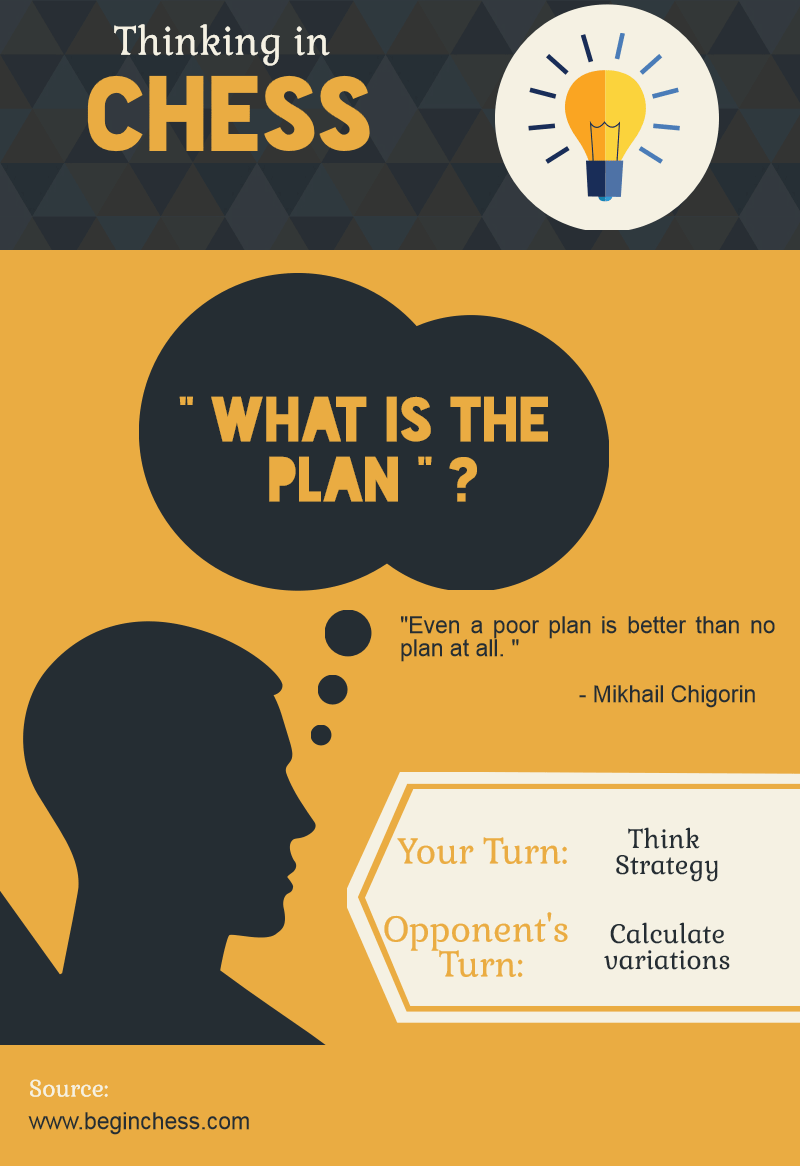
A common chess thought process heuristic is to think strategically during your opponent’s move and to calculate variations during your move.

How to Improve Your Strategic Play
Step one is to go over of master games, starting in chronological order with the games of Emanuel Lasker. This will give you a good foundation of strategic play. This will give you a good perspective of how strategic play has changed over the years. Play through circa 1927, when Capablanca lost the Chess Championship to Alekhine.
I would love to hear your feedback on how you define strategy in chess and what your thought process looks like.
[feather_share]